Overview
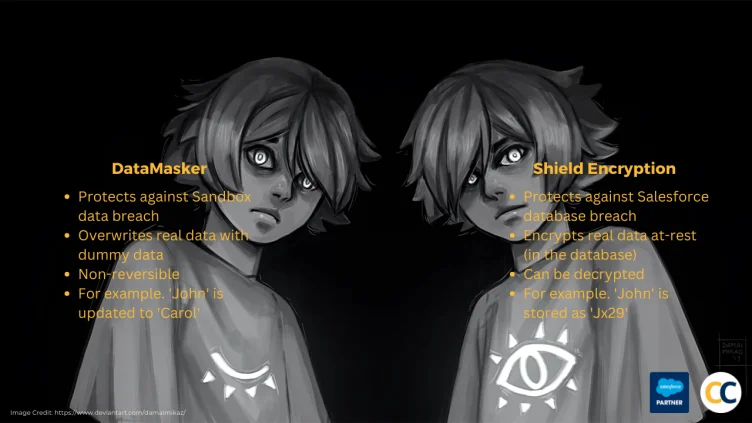
Salesforce provides businesses with the ability to protect their data from unauthorized access, both through Salesforce Shield Encryption and Sandbox Data Masking with DataMasker.
But what is the difference between these two?
In this blog post, we'll look at how Salesforce Shield Encryption and Salesforce Data Masking differ so that you can decide which data protection option is best for your business.
You may also decide that you need both.
What is Salesforce Shield Encryption?
Salesforce Shield Encryption is a data security solution offered by Salesforce that provides an extra layer of protection for sensitive customer data.
With Salesforce Shield Encryption, customer data is encrypted at the field level and stored in an encrypted format.
This means customer data is rendered unreadable while in transit and at rest, preventing unauthorized access to sensitive data.
It also includes options for data masking and other data security features, allowing customers to define what fields are encrypted or masked depending on their security needs.
As a result, Salesforce Shield Encryption ensures that customer data is safe and secure, giving customers peace of mind knowing that their data is always protected.
What is Sandbox Data Masking?
Salesforce Sandbox Data Masking with native tools like DataMasker is designed to help protect sensitive customer and company information in the sandbox.
DataMasker automatically replaces confidential data in Sandbox with safe, anonymized versions of the same information, ensuring that the data remains secure while still being accessible for testing, development, and training purposes.
Data masking is an important part of any organization’s data security plan, as it can help protect against data breaches, malicious activity, and other forms of unauthorized access.
With DataMasker, organizations can protect their data and ensure that only authorized personnel have access to sensitive information.
Key Differences Between Salesforce Shield Encryption and Sandbox Data Masking by DataMasker
Salesforce Shield Encryption and Sandbox Data Masking are two different methods used to protect data in a Salesforce environment.
While both are effective data security measures, there are key differences between the two.
Salesforce Shield Encryption is an encryption-based solution that works on production Salesforce orgs.
It provides enhanced security for sensitive customer data stored within the org. Shield automatically encrypts all data stored in Salesforce fields and custom objects marked as “Encrypted”.
This encrypted data is then securely stored in the Salesforce database and can only be decrypted by the Salesforce user/Org that has access to the decryption key.
On the other hand, DataMasker is a solution used only on Salesforce sandbox orgs.
DataMasker masks sensitive data stored in sandbox orgs to protect it from unauthorized access.
Data Masking replaces sensitive data with non-sensitive data with similar properties, such as dates and numbers, while preserving the data’s original structure.
This way, developers can work with realistic data sets without exposing sensitive information.
In conclusion, while both Salesforce Shield Encryption and DataMasker are effective data security solutions, they serve different purposes.
Shield Encryption is used on production Salesforce orgs to protect sensitive customer data, while DataMasker is used on sandbox orgs to mask sensitive data and keep it secure.
Check out DataMasker on AppExchange or learn more on Cloud Compliance’s DataMasker for Salesforce Sandbox.
Did we miss anything? Please share your thoughts here
Related Resources
How to Evaluate Salesforce Data Masking Tools: 12 Criteria That Matter
What Is Data Anonymization?
Anonymization is the only technique that takes data out of GDPR scope entirely. It is also the hardest to achieve, because relational data re-identifies itself through quasi-identifiers. Most teams who believe they anonymized their data actually pseudonymized it.
What Is Pseudonymization?
Pseudonymization replaces identifying values with substitutes while keeping re-identification possible using information held separately. That last part is why pseudonymized data stays in scope for GDPR, and why teams who think they have anonymized their sandbox usually have not.
Keeping Salesforce AI Compliant: The Privacy Gaps the Einstein Trust Layer Leaves Open
Agentforce and Einstein create privacy risks the Trust Layer only partly covers. See the DSAR, consent, and retention gaps and how to close them.
165M+ Records masked in Salesforce Sandbox with DataMasker
See how a major life insurer in Australia and New Zealand masked 165M+ records in Salesforce Sandbox in under 24 hours.
Learn More About Cloud Compliance
Explore our native Salesforce data privacy products.